Space
We summarize the week's scientific breakthroughs every Thursday.
- Planetary Science
Enceladus’ ocean may not have produced precursor chemicals for life
Building blocks of life have been found on this moon of Saturn. They may come from chemical reactions beyond Enceladus’ possible life-supporting ocean.
- Particle Physics
A primordial black hole may have spewed the highest energy neutrino ever found
The Big Bang may have spawned these theoretical black holes, whose lives are thought to end in a burst of extremely energetic particles.
- Space
How a Harvard maverick forever changed our concept of the stars
At just 25, Cecilia Payne-Gaposchkin applied quantum physics to a treasure trove of astronomical observations to show that stars are mostly hydrogen and helium.
- Planetary Science
Future Martians will need to breathe. It won’t be easy
Asteroid impacts, microbes, mining: These are a few tactics engineers might one day use to create an Earthlike atmosphere on Mars.
- Physics
A ‘ringing’ black hole matches scientists’ predictions
Gravitational waves emitted after two black holes coalesced agree with theories from physicists Stephen Hawking and Roy Kerr.
- Planetary Science
Seismic waves suggest Mars has a solid heart
NASA’s InSight lander listened to Marsquakes for four years. The tremors revealed that Mars may have a solid inner core.
- Astronomy
Astronomers detect the brightest ever fast radio burst
The fast radio burst came from 130 million light-years away. That proximity allowed an in-depth search for what produced the mysterious signal.
- Planetary Science
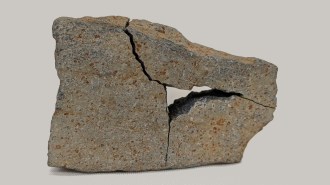
A Mars rock analysis tool proved its mettle on a chance find from Arizona
On Mars, the Perseverance rover found a spotted rock that could bear signs of ancient life. On Earth, a researcher used a lookalike for a dry run.
- Astronomy
A newborn planet munches on gas and dust surrounding its host star
In a first, astronomers imaged a baby planet within a gap in the disk of material around a star, confirming predictions about how rings form.
- Planetary Science
NASA’s Webb telescope spotted a new moon orbiting Uranus
Like Uranus's other 28 moons, the newfound object spotted by JWST will be named after a William Shakespeare or Alexander Pope character.
- Space
The Vera Rubin Observatory is ready to revolutionize astronomy
Sporting the world’s largest digital camera, the new telescope is poised to help solve some of the universe’s biggest mysteries.
- Astronomy
A dying star revealed its heart
Before exploding, a star shed most of its layers, giving a glimpse at a massive star’s deep interior. The event may represent a new kind of supernova.